


A new £1 million reconstruction of a 4,500-year-old Neolithic building at Stonehenge will transform educational visits from this autumn.
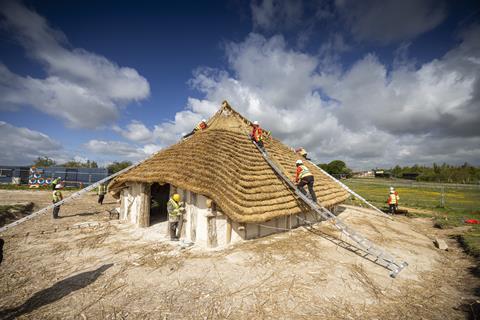
The Kusuma Neolithic Hall is based on archaeological evidence of a large prehistoric structure, found two miles away from the stone circle, and has been built by a team of English Heritage volunteers using historically authentic methods and locally sourced materials.
The £1 million project, funded by the Kusuma Trust, is in the final stages of construction and will be open to the public this summer, ahead of its use as a living-history learning space for school trips from September.
The first phase of a large-scale project by English Heritage to extend its capacity for learning visits and cross-curricular opportunities at Stonehenge, the Kusuma Neolithic Hall has taken a team of more than 100 volunteers nine months to complete.
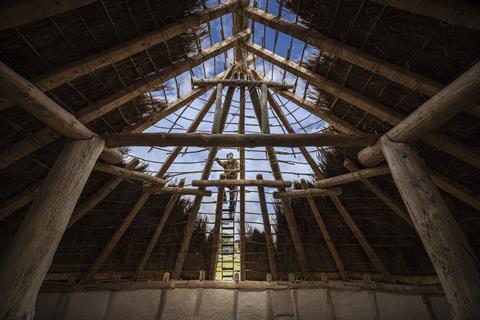
School groups will be taken back in time
Working under the expert guidance of award-winning experimental archaeologist Luke Winter, the charity’s volunteers have used historically accurate tools and materials (including thatch, coppiced timber and chalk daub) to recreate the building techniques used by Neolithic people and to better understand the work and timescales that would have been involved.
School groups of up to 30 students will be transported back in time as they gather around the hearth, handle replica tools, try out cooking and crafts, and discover what everyday life was like 4,500 years ago.
It is unclear exactly what the original structure, found near the prehistoric settlement Durrington Walls around two miles north-east of Stonehenge, was used for. Excavations of the settlement have found many thousands of animal bones and a vast quantity of Grooved Ware pottery, which provide strong evidence for vast winter feasts. This suggests that the hall may have been a space for large gatherings and celebrations, rituals or even burial practices.
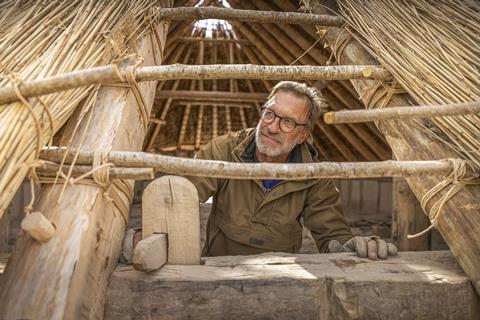
Neolithic Hall will transform learning experiences
Matt Thompson, conservation, curatorial and learning director for English Heritage, said: “The Kusuma Neolithic Hall is such an exciting project for the charity, and we are hugely grateful to the Kusuma Trust for the generous donation that made it possible. Not only is the hall a wonderful addition to the Stonehenge experience for both visitors and learners but, by using historically accurate techniques and materials in its construction, we have also been able to develop a much keener understanding of the everyday lives of the Neolithic people who came to Stonehenge and settled in the locality.
“As a charity, one of our main purposes is to provide everyone with memorable learning experiences and the Kusuma Neolithic Hall will transform our ability to do that. With its burning hearth, Neolithic crafts and cookery, the hall is a model for living history – instantaneously transporting you back 4,500 years. This summer, visitors to Stonehenge will also have the chance to experience the hall and speak to some of our wonderful volunteers who built it, before it is opened up to educational groups for the new school year.”
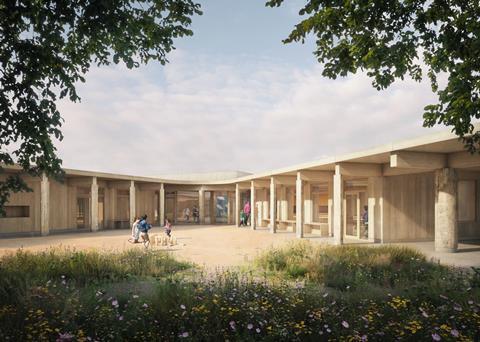
Inclusive Learning Centre at Stonehenge also due to open
In addition to the Kusuma Neolithic Hall, a new environmentally sensitive Learning Centre is due to open at Stonehenge at the end of 2026 alongside a STEM in Heritage programme for school visits.
Housing the Clore Discovery Lab, Weston Learning Studio, digital production studio, Wolfson Foyer and an open-air courtyard to support sensory learning, the Learning Centre will feature modern equipment and accessible, inclusive practical facilities, including a Changing Places space and a smaller breakout area for those with different educational needs.
School visit bookings
School trips to Stonehenge incorporating a visit to the Kusuma Neolithic Hall are now available to book for 2026/2027, as part of the site’s new STEM in Heritage programme.
English Heritage welcomes more than 200,000 school visits each year, offering free self-led trips to Stonehenge and more than 400 other historic sites across the country, as well as expert-led immersive Discovery Visit workshops linked to the National Curriculum.
For more information about English Heritage’s programme of school trips, to download teaching resources or to book, visit www.english-heritage.org.uk/learn/school-visits